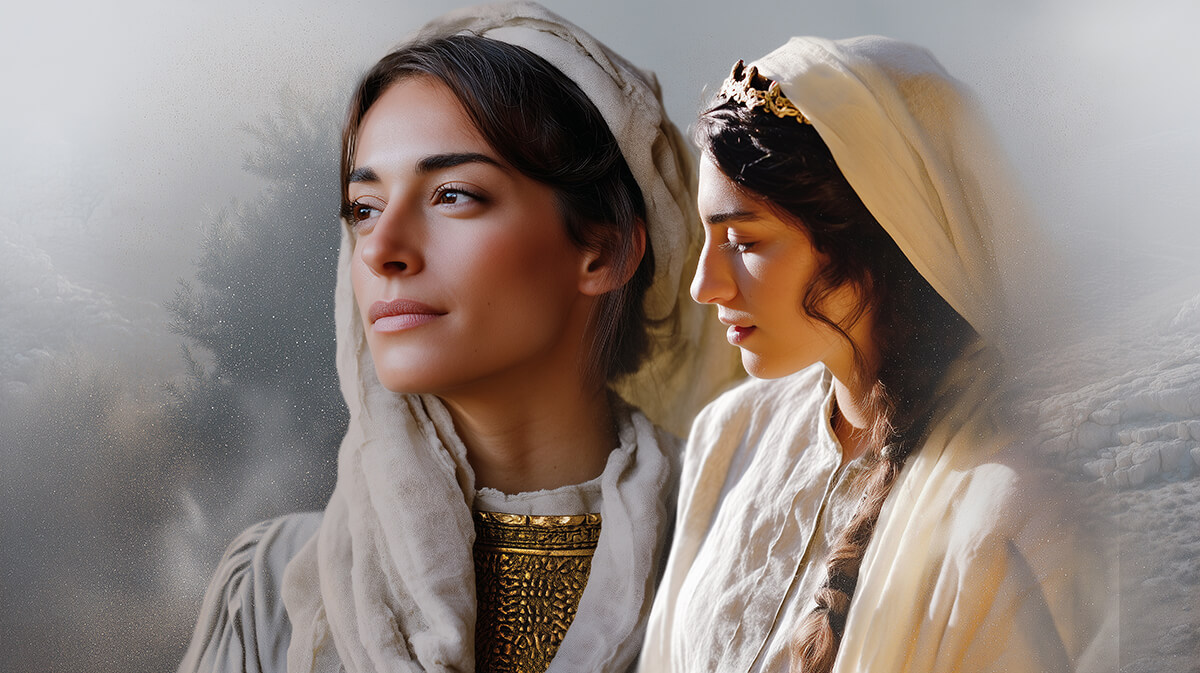
When we think of great women in the Hebrew Bible, familiar names immediately come to mind: Sarah and Rebecca, Rachel and Leah, Queen Esther, and prophetesses such as Miriam and Deborah. Yet woven through the biblical text are other women whose courage, intelligence, and spiritual depth also deserve attention. Though their names appear less frequently, they stand out as exceptional women who made their mark at decisive moments. A closer look at these lesser-known figures reveals lives marked by moral clarity, political insight, and inspiring inner strength.
In this article:
• Tamar: Righteousness in Dubious Disguise
• Serah Bat Asher: A Woman’s Healing Song
• Abigail: Diplomacy in the Making of a King
• Sources
Tamar: Righteousness in Dubious Disguise
Just after Joseph is sold into slavery and carried off to Egypt, the narrative takes an unexpected turn. Genesis 38 zooms in on Judah, the brother who had urged the sale. What unfolds is a story that is as uncomfortable as it is powerful. Tamar, the daughter-in-law of Judah, loses two husbands in succession, both sons of Judah, who die for their own wrongdoing. Judah promises her his youngest son, Shelah, according to the obligation of levirate marriage, but fails to follow through. Tamar is left suspended, bound to a family that will not secure her future, with no independent standing of her own.
But Tamar is neither naïve nor passive, and she takes control of her own story. In a bold and strategic move, she disguises herself as a prostitute and positions herself where Judah will encounter her. Before he approaches her, she asks for a pledge: his seal, cord, and staff, unmistakable symbols of his personal identity. What makes the story even more remarkable is what she does next.
Three months later, when her pregnancy becomes visible, Judah sentences her to death by burning for “harlotry.” As she is being led out, Tamar does not confront him directly. Instead, she sends the items to him through a messenger with a measured message: “I am pregnant by the man to whom these belong. Please examine: whose seal and cord and staff are these?”
Judah is forced to look at his own “identification” in front of witnesses. The irony is sharp: earlier he had urged his father Jacob to identify Joseph’s bloodstained cloak, sealing a deception. Now he must identify his own belongings and face the truth. Tamar does not name him outright, giving him space to confess rather than publicly humiliating him. He does. “She is more righteous than I,” Judah declares.
In that public admission, something shifts. The brother who once helped sell Joseph now accepts responsibility without excuse. Yet it is Tamar who has brought him to that moment. Through courage, strategy, and restraint, she secures both justice and her future. Judah takes her as his wife, and from their union comes Perez, ancestor of King David. From Tamar’s daring act emerges the royal line of Israel.

Serah Bat Asher: A Woman’s Healing Song
Serah bat Asher is easy to miss in the biblical text. She is mentioned briefly in Genesis 46:17 as one of those who go down to Egypt, and again in Numbers 26:46 in the wilderness census. Yet Jewish tradition refuses to let her remain a footnote. In Midrash and rabbinic literature, Serah becomes a woman of unusual wisdom, extraordinary longevity, and even prophetic insight, a living link between the generation of Jacob and that of Moses.
One well-known Midrash tells how Jacob’s sons hesitate to tell their father that Joseph is still alive, fearing the shock might overwhelm him. It is Serah who steps forward. Instead of delivering the news bluntly, she sings it to him, allowing the truth to unfold gently. For this sensitivity and wisdom, Jacob blesses her with long life. It is a story that gives music a sacred role: sometimes the right words need a tune to carry them home. For girls who love to sing, Serah offers a quiet reminder that a voice can comfort and heal.
According to later tradition, Serah is still alive at the time of the Exodus. She guides Moses to the hidden resting place of Joseph’s coffin in the Nile, ensuring that the oath to carry his bones out of Egypt is fulfilled. In this way, she connects patriarchs and prophets across generations.
Some traditions even number her among those who enter the Garden of Eden alive. Whether understood literally or symbolically, Serah bat Asher represents continuity and the enduring power of a gentle, faithful voice in the unfolding story of the Jewish people.

Abigail: Diplomacy in the Making of a King
We meet a woman who changes the course of events not from a throne, but from the roadside. Abigail appears in 1 Samuel 25 as the wife of Nabal, a wealthy man described bluntly in the text as “harsh and evil in his deeds.” When David, still on the run from King Saul, sends messengers requesting provisions in return for protecting Nabal’s shepherds, Nabal responds with insults and contempt. David, humiliated and enraged, sets out with four hundred men, determined to wipe out Nabal’s entire household.
At that moment, Abigail acts. Without her husband’s knowledge, she gathers generous supplies and rides out on her donkey to intercept David. What follows is not merely a plea for mercy, but a masterclass in moral and political clarity. She acknowledges the wrong, takes responsibility, and gently yet firmly reminds David of his greater destiny. If he stains his future kingship with personal vengeance, she warns, he will carry needless bloodguilt.
Her words reframe the moment: this is not about wounded pride, but about the character of a future king. According to the Talmud in Megillah 14a, Abigail is counted among the seven female prophets of Israel, and in this encounter we see why. She speaks not only wisely, but prophetically.
The story concludes with divine justice unfolding on its own. Nabal dies shortly afterward, and David marries Abigail. Yet the true turning point lies earlier, somewhere along a dusty road, where one woman’s courage prevents bloodshed and preserves the moral integrity of Israel’s future ruler. The Bible deliberately pauses to tell us this story – Nice to meet you, Abigail!

Sources
Primary Biblical Texts
- Genesis 38
- Genesis 46:17
- Numbers 26:46
- 1 Chronicles 7:30
- 1 Samuel 25
- Ruth 4:12
Talmudic Sources
- Babylonian Talmud, Megillah 14a
- Babylonian Talmud, Megillah 15a
- Babylonian Talmud, Sotah 13a
- Babylonian Talmud, Bava Metzia 59a
Midrashic and Later Rabbinic Sources
- Midrash HaGadol on Genesis 45:26
- Derekh Eretz Zuta

For more information about our research process, sourcing, and editorial review, please see our editorial standards and content policy.