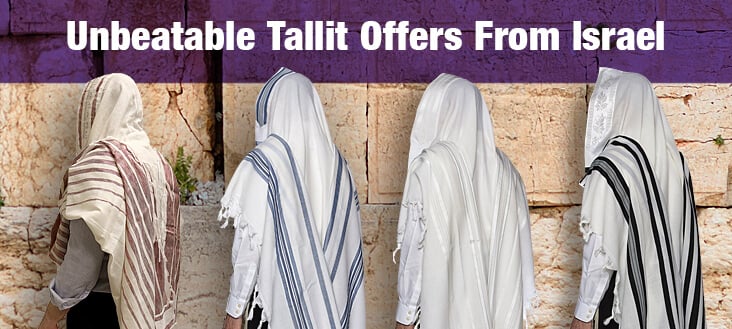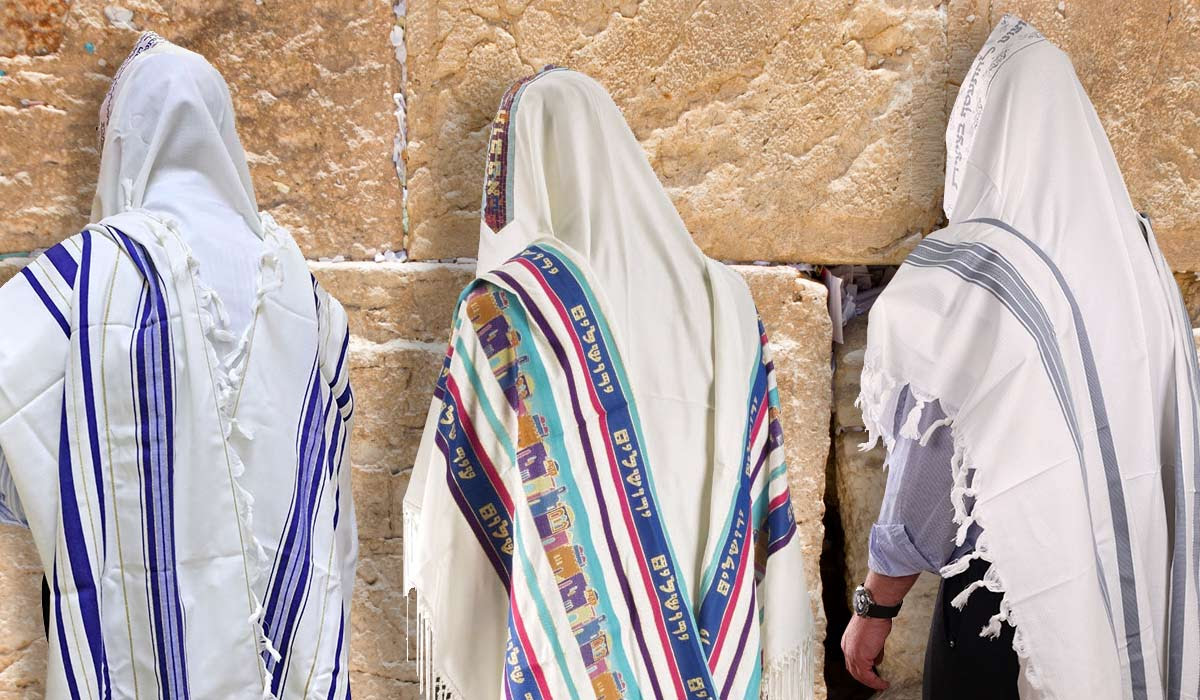
A kosher tallit is a large square of fabric that is generally white and used for morning prayers throughout the week and on Shabbat. The Jewish prayer shawl history starts in ancient Israel when during the day people would wrap their head and shoulders with a large white cloth to protect their skin from the sun, and at night wrap their bodies with it as the temperatures would drop in the desert. In the Torah, Jewish Bible, it was commanded that any 4 cornered garments should have fringes on each corner, so these cloths automatically had fringes put on them. As time went on, these large white garments were no longer necessary and the commandment was at risk at being lost. To keep the symbolic meaning of the tallit, the great rabbis of the time decreed that all men should wear this cloth, a tallit, whenever they prayed so that the commandment would be kept. Men receive a tallit either at their Bar Mitzvah at age 13 or at their wedding depending on their custom. These tallits are also called “Tallit Gedolah”. A “Tallit Ketan” refers to tzitzit, a four cornered shirt worn all day by Orthodox men.
How to Wear a Tallit
Before putting on the Tallit, one says a blessing and then places over their shoulders. The Tallit blessing is about the act itself. If the man is a Kohen-priest- then during the Priestly blessing, done every day and Shabbat in Israel and only over the big Jewish holidays for the rest of the world (Rosh Hashanah, Yom Kippur, Sukkot, Shavuot and Passover), the Tallit is worn over their heads and arms so that their faces and hands cannot be seen.
Strings of the Tallit
On each of the four corners of the tallit, are a set of knotted strings. For each corner, there is a total of eight threads with five knots. The way the knotting is done is differently according to each person’s heritage and tradition, however there is meaning behind the knots and the number of threads. The word tzitzit, the name of the threads in Hebrew, has the numerical equivalence of 600. If you add that with one set of strings (eight) and the number of knots (five), you reach the number of 613, which is the same number of commandments given to the Jews at Mount Sinai when they were given the Torah (Jewish Bible).
Techelet
Some choose to add blue string to each corner called techelet. In the Torah, it says that tallits back then had blue string on them and that blue was a color of Jewish royalty. The blue dye had come from a specific sea animal, which we are not sure of anymore, so the tradition has mostly been lost but some think they have found where it comes from so once again, people are using the dyed strings on the tallits.