For thousands of years, Jews have been living in Jerusalem, but it was not always the magnificent and large city that it is today; with dozens of neighborhoods and about 902,000 residents. In the past, Jerusalem was limited to the area of the Old City, where people found safety within its large stone walls, guarding them from thieves and fears of the desert. In the late 1800s, a problem arose where the Jewish Quarter of the Old City was overpopulated, and there was nowhere else to go.
Moses Montefiore, a British banker, activist, and philanthropist made a visit to Jerusalem in the 1820s which eventually changed his entire life. Montefiore heard about the problems of the Jews in the Old City and in the 1860’s, decided to establish the neighborhood of Mishkenot Sha’ananim, on a hill right across from the Old City. A beautiful community was constructed, with far better living quarters than the Old City had to offer. But still, the residents of the Jewish Quarter were hesitant to leave because of the unknown dangers that lay outside of the old city walls. Montefiore therefore had a stone wall and gate built around Mishkenot Sha’ananim and offered people money to move there as incentive. Only then did the neighborhood begin to grow.
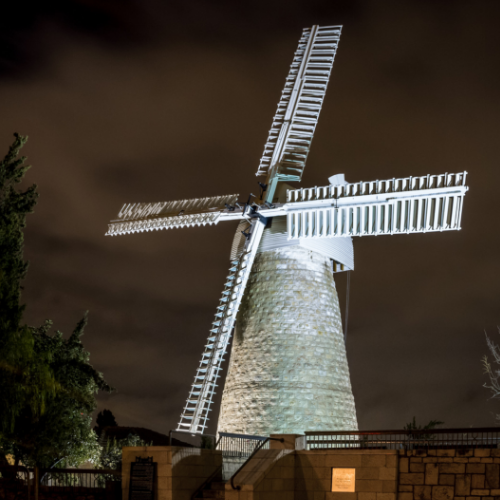
In 1857, Montefiore sponsored the construction of a flour windmill at the top of the hill where Mishkenot Sha’ananim is located. This provided cheap flour to poor Jews and allowed everyone to eat. Montefiore also donated a printing press and textile factory to the area, specifically for the use of the Jewish people of Jerusalem. In 1892, Montefiore helped fund the neighborhood around the windmill, which is now known as the upscale neighborhood of Yemin Moshe.
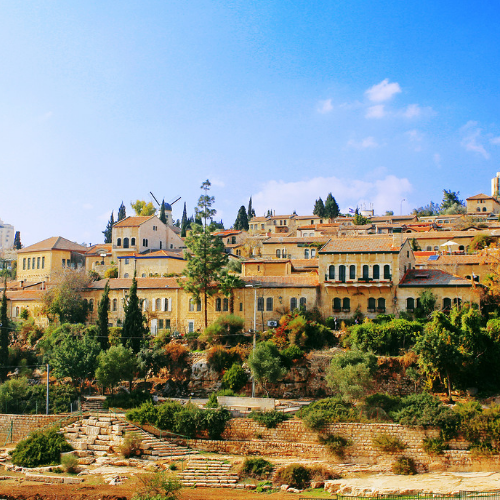
These two neighborhoods were key parts to the expansion of Jerusalem, helping people no longer be afraid of what lied outside the Old City walls. Today, one can go visit these two neighborhoods. Of which, Mishkenot Sha’ananim has been fully restored and Yemin Moshe still looks almost as it did in the late 1800s, early 1900s, with a few modern changes and many more homes. For all of Jerusalem, we have to give thanks to Moses Montefiore who made the city’s first expansion possible.