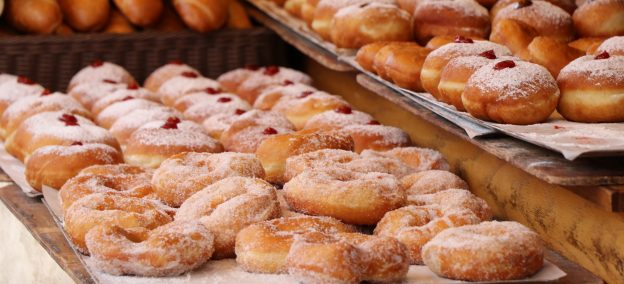
A few things come to mind when thinking about Hanukkah– lighting the Hanukkah menorah together and singing the traditional songs, making latkes, playing dreidel, buying the perfect gift for someone, and of course, eating a jelly donut. Some of these things are directly relevant to the story of Hanukkah such as lighting the menorah and playing dreidel, but where does the delicious jam-filled donut come from?
Well, on Hanukkah it is tradition to eat fried foods which is one explanation to why we eat latkes and these donuts, but lets take a deeper look into the history of the jelly donut or sufganiyah as they say in Hebrew.
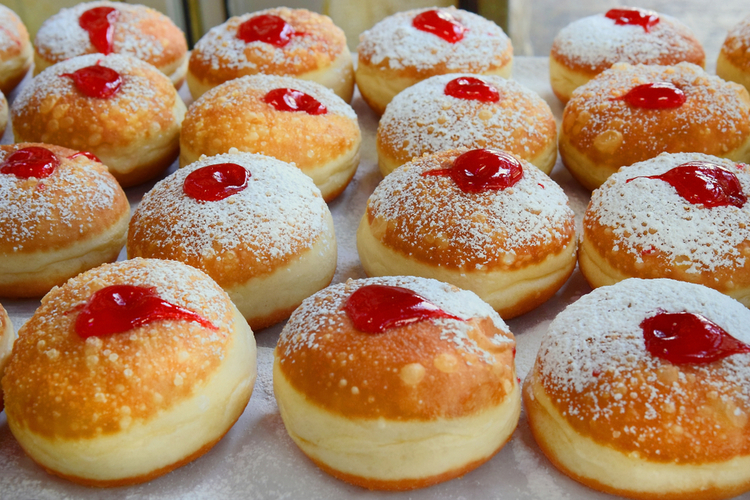
The sufganiyah takes Israel by storm in the months leading up to Hanukkah and over 10 million are consumed around this time of the year. Today, there are dozens of types of sufganiot such as caramel filled, alcohol infused, and chocolate covered, but nothing beats the original strawberry jam-filled donut sprinkled with a layer of powdered sugar. It’s finger-licking good!
The original jelly donut comes from Europe, with the first recipe found from the 1500s. It started off in Central Europe, when meat and savory foods would be fried between bread in lard. Later on, sugar was imported from the Caribbean at a cheap price, so people began to fry jelly inside and sprinkle sugar on top as a delicious dessert which quickly spread across Europe. In Yiddish these were known as ponchiks, and were commonly made for Hanukkah in Ashkenazi communities, particularly in Poland, as we eat fried foods to remember the miracle of the oil that lasted for eight days.
Just as the Jews from Europe made aliyah in the early 1900s, so too the jelly donut came with them. In the 1920s, as Jews were beginning to really establish themselves and build up the country, the Histadrut- the Israeli labor federation, decided that they were going to make the ponchiks the official food of Hanukkah. While latkes were more widely popular, they could be made at home, whereas making jelly donuts required professionals, and would provide jobs. Bakers worked day and night and came out with hundreds of jelly donuts, whose name was then changed from ponchik to sufganiyah. The word sufganiyah comes from words in the Tanach that meant “spongy” because of the texture of the fried dough.
The sufganiyah is still the most popular Hanukkah food in Israel and is now also sold in American Kosher bakeries this time of the year and enjoyed by all. Moroccan Jews have their own special donut called sfenj, the Arabic word for spongy, which is also fried dough with sugar on top, but instead of having jelly inside, it is soaked in honey.
This Hanukkah, feel free to explore the different kinds of donuts! Make your own, buy from the store, you can never go wrong- plus it is now part of how we celebrate the miracle of Hanukkah, especially in the Land of Israel.
Enjoy and Happy Hanukkah!